

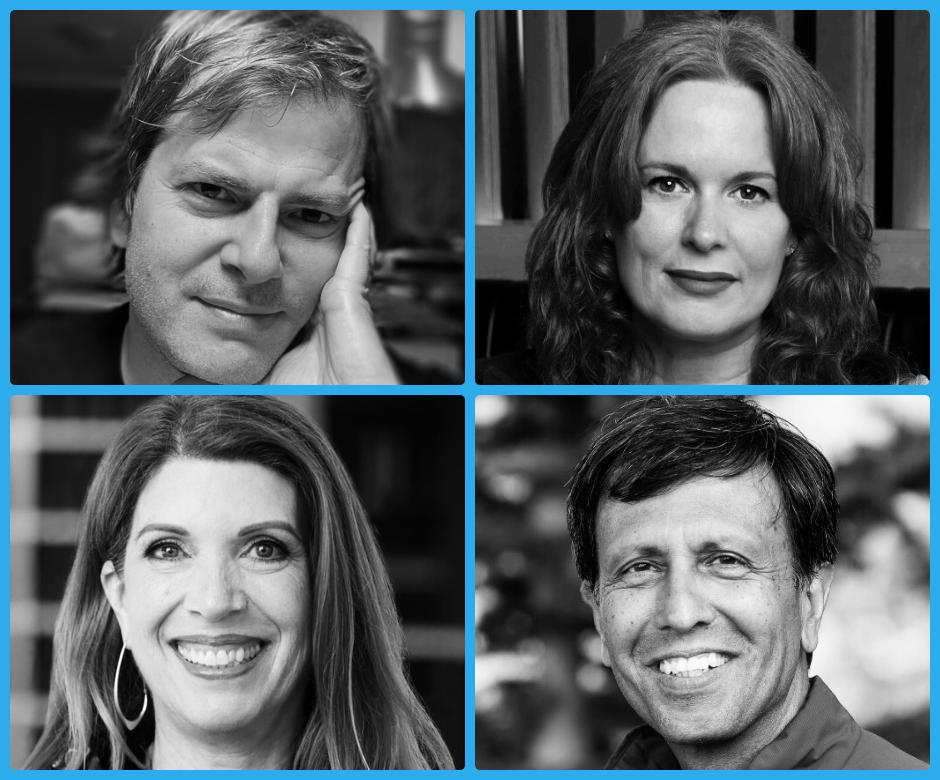
Big Path Capital’s annual MO 100 Top Impact CEO Ranking is our opportunity to celebrate a group of distinguished executives who are leveraging the engine of capitalism to create shared prosperity and drive positive impact. By leading high-growth impact companies — the average revenue of the companies featured is $88 million with an average growth rate of 18% — these leaders provide inspiration and validation that business can be a force for good while also generating strong financial returns.
The 2026 awardees champion the opportunities they’ve created through business models built around purpose. As Melanie Dulbecco, Torani CEO and MO 100 honoree, says, “this kind of impact doesn’t mean sacrificing competitiveness; in fact, it’s the best way to outperform.”
The MO 100 CEOs represent businesses from across the U.S., as well as Canada, the Netherlands, Singapore, and Belgium. Their companies span all sizes and sectors, ranging from banking and technology to consumer and industrial products, food and agriculture, and healthcare. What unites them is the determination and fortitude to lead with mission and values in the forefront, even in the face of challenges and uncertainty.
“These CEOs are driving the new economy where profit and prosperity not only co-exist but co-create new and lasting stakeholder value,” says Big Path Founder and CEO Michael Welchel. “The MO 100 Top Impact CEOs champion a new vision of capitalism, demonstrating that every transaction represents an opportunity to create positive outcomes for all stakeholders.”
Big Path will recognize the honorees at the MO 100 Awards Gala during the MO Summit, March 16-18, in Asheville, North Carolina.
In this Q&A, we highlight four of our remarkable 2026 MO 100 leaders. Each shares their point of view on using capitalism to drive a more sustainable future, how impact influences their bottom line, challenges they’ve faced, and the advice they’d give other impact leaders.
- Aseem Das, Founder and CEO, World Centric
- Brenna Davis, CEO, Organically Grown Company
- Melanie Dulbecco, CEO, Torani
- Andy Hunter, Founder and CEO, Bookshop.org
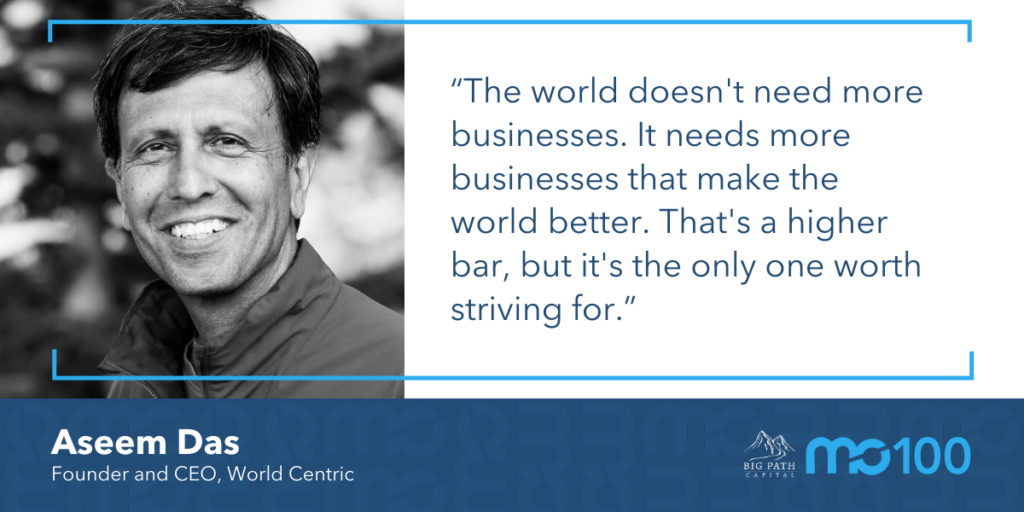
Aseem Das, Founder and CEO, World Centric
Aseem Das is a repeat MO 100 honoree for his leadership at World Centric, a manufacturer of compostable and reusable foodservice and packaging products that gives 25% of its profits to social and environmental organizations to further their work in creating a better world.
What does it mean to you to leverage the engine of capitalism to create a more just and sustainable future? Why is this important to your business and to you as an individual?
I question the premise that capitalism can create a better future. By design, capitalism demands private ownership and the accumulation of profits/wealth as its primary goal. The system is built on resource extraction, externalizing costs to the environment/society, and labor exploitation. Investment capital also seeks high profits and growth, reinforcing wealth accumulation. However, businesses operating within this system have choices about how they operate. These choices do not transform capitalism into something it is not, but they do reduce the harm we cause and increase the good we contribute while operating within the system.
A single business like World Centric can not create a more just and sustainable future. Systemic problems require systemic solutions such as policy changes, shifts in power, fundamentally different economic structures, and a shift in human consciousness. But while we aspire toward that larger transformation, I believe we have an obligation to operate as ethically as possible.
We face accelerating environmental crises, such as climate change, biodiversity loss, plastic pollution, resource depletion, and other major issues. We also face staggering social inequalities and the preventable suffering of billions of people who lack access to clean water, sanitation, healthcare, and education. Given these realities, I believe businesses should exist primarily for the benefit of society, not for the personal enrichment of owners and shareholders. Only then can they create a more sustainable future.
What are the top challenges you’ve faced in using business to drive impact? What do you consider your greatest success in this area?
The challenges have been constant and varied. In the early years, the biggest struggle was simply not having enough — not enough cash, people, or infrastructure — to match our growth. At times, it felt impossible for us to continue, as we had not taken any outside investment and were dependent solely on our sales for our growth.
External factors have tested us repeatedly. COVID disrupted our supply chains and customer base almost overnight. We serve the foodservice industry, and when restaurants, cafeterias and eating establishments closed, our business felt it immediately. More recently, tariffs have created new cost pressures, leading to reconfigured supply chains, increased costs, and difficult decisions about pricing and margins.
As for our greatest success, I am most proud of the giving we’ve been able to sustain. To date, World Centric has donated over $20 million to grassroots organizations worldwide. We’ve partnered with organizations like Spark Microgrants in Rwanda and Burundi for over a decade, supporting community-led development. We work with Raising the Village in Uganda to help households move out of extreme poverty. We fund SOIL in Haiti, which is building sustainable sanitation infrastructure in one of the most challenging contexts imaginable. We also mitigate our carbon emissions by supporting indigenous communities to protect their ancestral lands, helping keep forests standing, and avoiding extraction of resources from these lands. These are long-term commitments to organizations doing difficult, transformative work, and I am proud to have supported these causes.
Is impact important to your company’s bottom line? How/why?
Impact is not separate from our bottom line. We exist for impact. Our products provide sustainable alternatives to single-use disposable packaging. While they are not perfect, they significantly reduce the waste and pollution associated with plastic and Styrofoam disposable packaging. Our customers — universities, hospitals, restaurants, or retailers — increasingly make purchasing decisions based on values alignment. Students pressure their campus dining services to eliminate single-use plastics. Healthcare administrators question the wisdom of serving patients on petroleum-based products known to leach chemicals. Millennial parents push school districts to make better choices for their children. We exist to meet that demand with products that actually deliver on the promise of sustainability.
We have long employee tenures because the work is meaningful. It is difficult to find businesses that are doing good in the world and work that has meaning beyond the paycheck. When your job contributes millions in donations to organizations fighting poverty and protecting ecosystems, it creates engagement and retention that pure compensation cannot replicate.
And our structure keeps us accountable. The 25% profit pledge is built into how we operate. Our B Corp certification and Benefit Corporation status keep us aligned with our core purpose to exist for the good of the world, even when times get hard.
What would you share with other CEOs who aspire to drive impact through their business leadership?
Structure your business from the start with the goal/purpose of creating social good, not as an afterthought. That means building a business that truly has the good of the world at heart — paying fully for externalized costs to the environment/society, ensuring fair living wages throughout the supply chain, minimizing the extraction of resources, and supporting other organizations working on creating positive change.
Building a mission-aligned culture is critical. Skills can be taught, but values alignment is harder to come by. Hire people who genuinely care about the work, not just the paycheck, especially when it comes to senior roles, as they are instrumental in shaping and growing the culture. The right team, aligned around a shared purpose, will carry the business through difficulties that would break a team held together only by compensation.
You need intention, persistence, and effort. Building an impact-driven business is harder than building a conventional one. The companies that succeed are the ones that stay focused, put in the effort day after day, and refuse to abandon their mission when it gets difficult.
In closing, the world doesn’t need more businesses. It needs more businesses that make the world better. That’s a higher bar, but it’s the only one worth striving for.
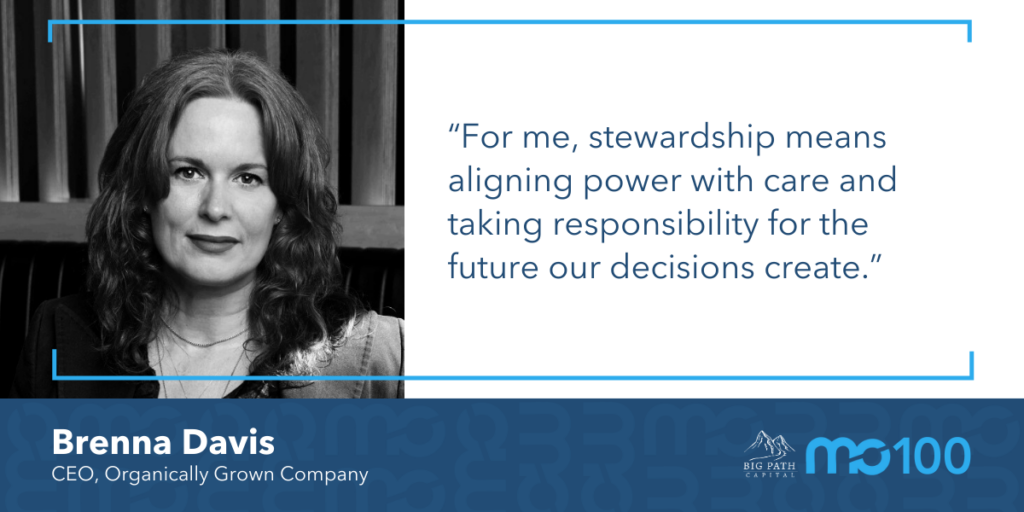
Brenna Davis, CEO, Organically Grown Company
Brenna Davis is a repeat MO 100 honoree as CEO of Organically Grown Company, the nation’s only trust-owned and largest wholesale distributor dedicated to organic fresh produce, supporting farms big and small.
What does it mean to you to leverage commerce to create a more just and sustainable future? Why is this important to your business and to you as an individual?
Leveraging the engine of capitalism begins with a choice: to direct the forces that already shape our world toward outcomes that support life and justice over the long horizon.
Capital moves quickly and has far-reaching impact. It shapes how food is grown, how people experience work, how communities navigate change, and how the future is financed. When that power is guided with intention and governed with care, it has the potential to regenerate rather than deplete.
At Organically Grown Company, we chose to embed purpose directly into ownership and governance through a Perpetual Purpose Trust, so our values remain protected beyond any one leader or market cycle. That structure enables us to lead with a long view, remain steady during uncertainty, and invest in relationships that strengthen growers, customers, and communities over time.
This work matters to me personally because I learned as a child how business can be both a positive and a destructive force and that economic decisions shape landscapes, livelihoods, and community health, often long after those choices are made. That awareness stayed with me and shaped how I lead. I have spent my career building socially and environmentally responsible businesses because I believe capitalism is at its best when it is designed to serve life, not just short-term gain. For me, stewardship means aligning power with care and taking responsibility for the future our decisions create.
What are the top challenges you’ve faced in using business to drive impact? What do you consider your greatest success in this area?
Throughout my career, one of the greatest challenges has been staying focused on long-term responsibility in environments that reward short-term results. Impact takes time, while markets often move quickly. In those moments, leadership asks for calm judgment and the confidence to make thoughtful decisions, even when everything is not resolved.
Another challenge has been helping organizations see impact as part of how the business runs every day, not as a separate set of initiatives. That shift shows up in governance, incentives, and daily choices, and it takes steady leadership to build shared understanding and trust.
My greatest success has been developing the ability to hold fiduciary responsibility and mission together with clarity and care. I have learned how to protect enterprise strength while advancing long-term social and environmental outcomes, especially under pressure.
Is impact important to your company’s bottom line? How and why?
The health of the food system directly affects the health of our business. As consolidation continues across agriculture, natural foods, and consumer packaged goods, pressure increases on independent growers, regional producers, and values-driven brands. Retailers face fewer choices, shoppers experience less transparency, and communities lose resilience.
As a stable, independent food distributor, we play an important role in holding the system together. By supporting independent growers, natural food retailers and co-ops, and mission-driven brands, we help maintain continuity, trust, and choice across the supply chain. That stability allows our partners to remain viable and responsive to their communities, even as the broader landscape shifts.
This approach strengthens our business, as well. Long-term relationships, shared values, and reliability create resilience during disruption and confidence during change. Over time, supporting a more balanced and resilient food system supports strong financial performance by reinforcing trust, continuity, and sustainable growth.
What would you share with other CEOs who aspire to drive impact through their business leadership?
Think early and thoughtfully about how your business is designed, knowing that no one steps into leadership with all the answers. Governance, incentives, and accountability quietly shape whether impact holds over time or rests on individual effort alone. Alternative ownership structures offer one practical way to protect purpose while also supporting long-term enterprise strength.
Leading for impact often means holding complexity that has no clean resolution. The path is rarely linear, and the pressure to move quickly can be intense. In those moments, teams look to their leaders for steadiness, clarity, and reassurance that the work still matters, even when the answers are incomplete.
After spending my career building socially and environmentally responsible businesses, I have learned that impact leadership is deeply human work. It asks leaders to stay present, to care for themselves as well as their organizations, and to make decisions that reflect values while carrying real responsibility. When leaders lead with compassion for themselves and others, they build organizations that succeed in the market and create impact that lasts. Showing up for each other in the spirit of compassion is one of the most sustainable actions we can take in our world today.
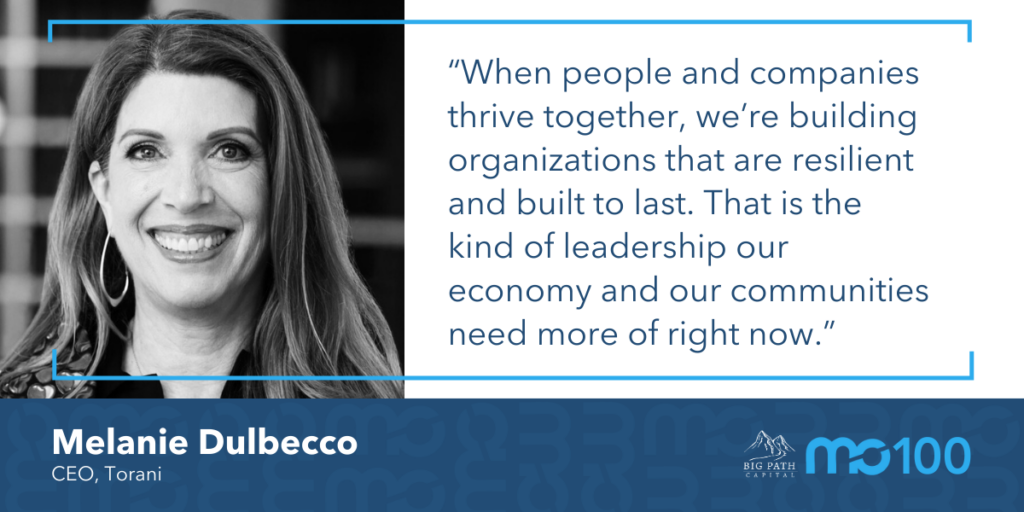
Melanie Dulbecco, CEO, Torani
Melanie Dulbecco is a repeat MO 100 honoree for her leadership of Torani, a B Corp flavored syrup company founded in 1923.
What does it mean to you to leverage the engine of capitalism to create a more just and sustainable future? Why is this important to your business and to you as an individual?
Since joining Torani 35 years ago, I’ve been working with the team to figure out a different kind of business model – one designed to ensure our business and our people succeed together. And we’re proving this approach works, sustaining over 20% average annual growth for more than three decades, maintaining zero layoffs, high retention, and thriving team members.
Capitalism is a powerful system. It can extract value for a few or compound value for many. We have chosen the second path at Torani. We’re using business as a platform to expand opportunities for all stakeholders. We believe this makes us more resilient, more innovative, better prepared for uncertainty, and a whole lot happier in our work together. Personally, it’s a joy to build a business in this way that widens the circle of success.
What are the top challenges you’ve faced in using business to drive impact? What do you consider your greatest success in this area?
One of the biggest challenges in business is resisting short-term thinking and the narrow focus on financials as the only success criteria, especially during moments of pressure. When costs rise or uncertainty hits, businesses often react by pulling back from people first.
We believe this is the exact opposite of what companies should do, as it weakens the very capabilities we need to recover and grow. At Torani, we’ve proven this again and again, most recently during the early days of COVID. While many leaders went right to layoffs, we went straight to figuring out how to take care of our team and hold tight to a nearly 100-year no-layoff streak. This wasn’t just how we survived the pandemic; in the end, it was how we developed resilience and emerged with momentum.
The greatest success is the shared success of our company and our team members while maintaining an extraordinary track record for company growth. Our next challenge is to continue pushing the boundaries of this way of working and to share and expand this way of thinking about business.
What would you share with other CEOs who aspire to drive impact through their business leadership?
Financial statements often miss where value is created. Financials are a trailing measure of success. You can look back in time and see a track record, but not necessarily what created it. The leading indicator is found in the learning, growth, and development of our teams. That’s where the real momentum comes from.
At Torani, we focus on building stable, reliable jobs that offer opportunities for learning, growth, and development, and then we share success. For us, sharing success means profit sharing, bonuses, and ESOP shares for every single team member, no matter their level or tenure. Pair that with giving people a real voice and choice in their work and development, and you create real opportunities.
This kind of impact doesn’t mean sacrificing competitiveness; in fact, it’s the best way to outperform. When people and companies thrive together, we’re building organizations that are resilient and built to last. That is the kind of leadership our economy and our communities need more of right now.
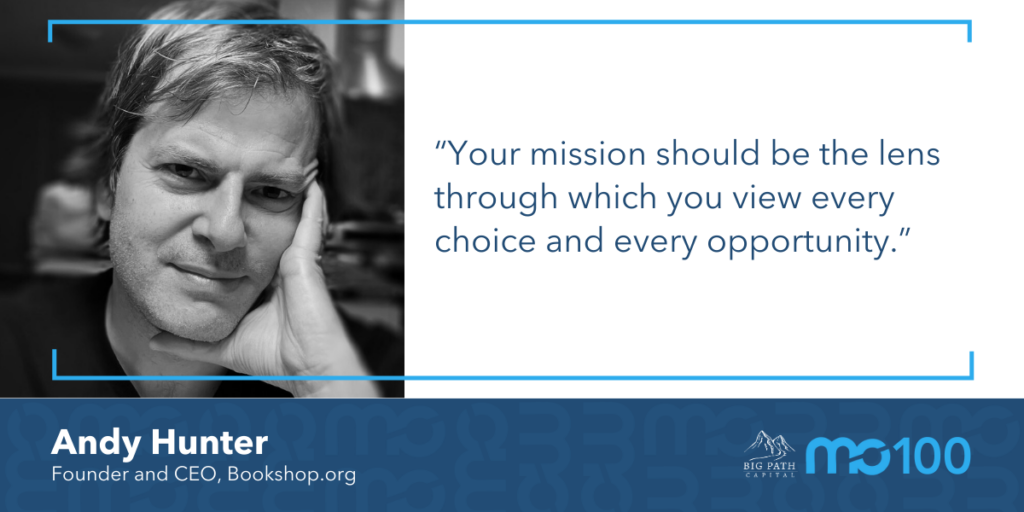
Andy Hunter, Founder and CEO, Bookshop.org
Andy Hunter is the founder and CEO of Bookshop.org, an online bookstore with a mission to financially support local, independent bookstores. This is his first time as a MO 100 honoree.
What does it mean to you to leverage commerce to create a more just and sustainable future? Why is this important to your business and to you as an individual?
Economic activity, including how we shop, is perhaps the strongest single force shaping the world and our future, yet the impacts of our habits are often invisible to us. To create positive change, we have to view our work holistically and ensure it serves humanity.
For most people who are just trying to make a decent life, it’s not easy to be an ethical consumer. That creates an opportunity for business leaders. By making it just as easy to do good, you can help people make choices that benefit them, their communities, and their futures.
What are the top challenges you’ve faced in using business to drive impact? What do you consider your greatest success in this area?
It often takes more work and costs more to be a socially conscious company. It can be less profitable and less appealing to investors. Our greatest success has been proving the skeptics wrong. When I first pitched the idea of Bookshop.org, nearly all investors felt that if Amazon beat us on price and speed, we didn’t have a chance. But I knew people loved their local, independent bookstores, and that many consumers were willing to pay more for clean energy, local produce, handcrafted goods, and more. I believed there were ethical consumers who would feel great about supporting their local bookstore when they bought books online. And there were. We’re now twice the size of the projections in my original pitch deck.
Is impact important to your company’s bottom line? How/why?
The entire company was founded for impact. We’ve been instrumental in bringing back local, independent bookstores. Every year since our launch in 2020, more bookstores have opened than closed. The American Bookseller Association has grown from 1,900 members to 3,200 — 73% of those stores grew year-over-year in 2025, and 90% of them are part of Bookshop.org. We’ve grown online sales for local bookstores by 600% over 5 years and sent over $52 million to bookstores in the US and UK.
Six years ago, if I had announced that there would be an incredible resurgence of local independent bookselling and that over 1,000 new stores would be thriving, no one would have believed me. But it’s true. Bookshop.org is only partially responsible for this resurgence — it is mostly due to the passion and inventiveness of the booksellers themselves — but we couldn’t be more pleased with how it’s turning out.
What would you share with other CEOs who aspire to drive impact through their business leadership?
Your mission should be the lens through which you view every choice and every opportunity. When you’re mission-focused, you can stay lean and make the right choices to have maximum impact. And that mission needs to be something you truly believe in, that fuels you, as starting and growing a business is hard — having an impact you can measure makes it much easier.