

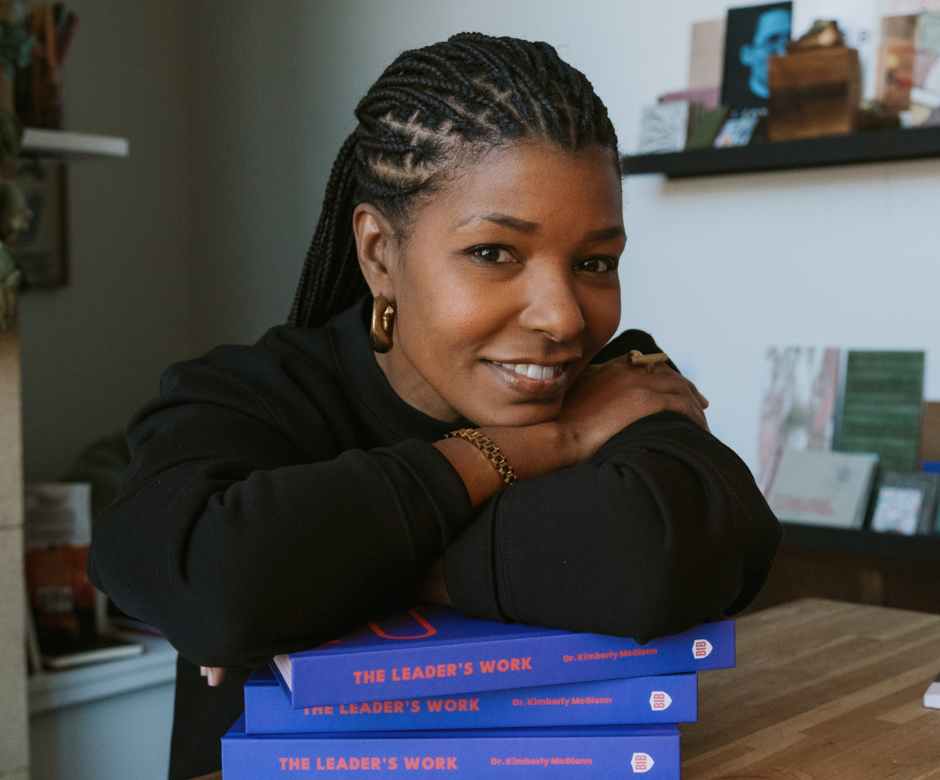
“Particularly in times of widespread uncertainty, it’s really important for the sake of morale that teams understand where their leaders stand.”
For Dr. Kimberly McGlonn, that clarity isn’t a soft skill. It’s an essential position.
“In an era where we’ve been so interested in charisma as one of the primary sources of social capital for leaders,” she says, “only 10% of employees find their leaders to be moral. We’re in this crisis of culture where people ultimately don’t trust that their leaders can consider and advocate for the common good.”
Throughout her robust career — from high school English teacher to fashion designer to author — McGlonn has championed a vision of business leadership that centers justice, dignity, and sustainability while demonstrating how to align profit with purpose. In her leadership roles, McGlonn says morality is her north star.
At the 2026 MO Summit (March 16–18 in Asheville, North Carolina), McGlonn will introduce her new “Leader’s Work” framework, designed to help high-growth, positive impact leaders cultivate inner governance, moral coherence, and the courage to act in turbulent times.
In the conversation below, we spoke with McGlonn about chaos as a test of leadership, optimism as a discipline, and why now is a moment of burning off, not burning down.
You argue that chaos isn’t a threat to leadership, but its greatest test. How can mission-driven leaders leverage today’s volatility to strengthen both their businesses and their impact?
One of the terms we often think about in business is our “substantial market differentiator.” That applies to who we are as institutions and organizations writ large, and to who we are as leaders within them. What I think this moment gives us is an option. A lot of people are like, “Oh my gosh, it’s all burning down. I feel so overwhelmed with the ways in which what we have perceived as normal is being challenged.”
I actually think this is a moment of burning off, not burning down. What’s burning off are practices and defaults that no longer serve what we need to survive the climate crisis, both the physical crisis facing the natural world and the test that democracy is facing. This is an opportunity that will clarify where we stand. This isn’t a new challenge for leaders. I go back to Dr. King, who, in ‘68, called for a revolution of values. We’re still kind of living in that moment of deciding how much maturity we will act with, or around what we inherit. This is a test of our maturity.
What do you see as the most pressing and perhaps underestimated challenge impact business leaders are facing right now?
I think it might be a test of a crisis of optimism, or a growing sense of nihilism. One of the most challenging things leaders need within themselves, so they can communicate it to their teams, is a genuine marriage to a spirit of optimism. Once you get past that cliff — the belief that better is possible — and begin imagining positive futures, or even recognizing your own agency in shaping them, you can build a healthy internal cultural climate that gets people back to the table and believing that what they’re doing has worth. I think that optimism is how we fend off stress responses to all of the uncertainty.
You’ll be introducing your new “Leader’s Work” framework during your MO session. Can you give a preview of what this framework entails?
There are four pillars. The first is the need to cultivate inner governance. Often, when we think about leaders, they’re at the front of the room or at the head of the table, but I think we should be much more skeptical about how they navigate their own internal landscapes. One of the things I’m interested in dedicating my next chapter of leadership to is cultivating a different language around inner governance and inner architecture, so leaders can be more sturdy in a storm. Once we get to that level of governance, that internal sturdiness, then we can start to examine what our morals are and how we develop the second pillar, which is moral coherence.
Once we reach that moral coherence, we can begin to think about where we need to act and communicate with more courage. We know what we stand for. We know what we care about. We know our one-, two-, three-, or four-pillar issues, communities, and concerns that we really want to focus our decision-making around. The fourth pillar is then aligning our decisions with a vision for a positive future.
What would you say to business leaders who believe purpose and profitability can’t coexist?
I think what they’re trying to grapple with is “Can capitalism behave with a sense of morality?” The version of capitalism that we’ve inherited is a very toxic mirage of who the winners are, and it takes no consideration for how we all lose when we abandon our defense of human dignity. What it encourages us to do is pretend that our survival and success are in no way entangled with the survival and success of other humans. What we see when that plays out is a complete and total annihilation of all dignity. It’s not a matter of if it can exist. That’s part of the experiment we still need to test and push forward with. There is no other option but that.
What do you most want people to take away from your MO session?
I hope they re-examine their individual power and agency in shaping outcomes for the entire planet. I think we’ve been conditioned to think really small about the scope of our influence. I hope that they feel encouraged to reimagine how they can differently position themselves as leaders in their sectors and as legacy leaders in their brands, and to recognize that they cannot afford to squander the self-examination that being a leader in turbulent times demands. I hope it encourages them to think smaller so they can play bigger.
What helps you stay grounded and keeps you motivated as a leader amidst the chaos?
There are a few things that keep me grounded. One is that I keep front of mind that we’re on a larger continuum of human existence that’s always been challenged by the same things — tyrannical leaders, exploitation of workers and lower “classes,” the sense of not needing to lead with a real moral compass.
I continue to remind myself that within that arc, I am individually small. That takes the pressure off my chest of feeling like I’m responsible for fixing it all. Because I can give myself the breathing space to remember the light, I can also remind myself that the light is bigger, stronger, and more powerful than the forces of darkness. That position helps me to parent. It helps me to lead my team. It helps me pursue my own reading and writing and practice being still in nature.
As leaders, we’re all going to have to make some really intentional choices about our truths and what we believe. Then we’re going to have to return to practices that remind us of those so that the cacophony of negative stories doesn’t win in our minds. When negativity wins in our minds, it wins in how we lead. It makes us weak and defeatist.
The people I’ve admired throughout that arc of human history — from Gandhi in India to Mandela in South Africa to Dorothy Day in New York — they weren’t people who surrendered to a spirit of defeat, even in the face of incredible odds. They believed that their individual legacy wasn’t tied to the larger outcome but to what they were committed to. So I focus on what I am standing up to and what I am standing for.
Explore the full 2026 MO Summit agenda and speakers — and register to attend!